Thoughts: There’s your light

When another person makes you suffer, it is because he suffers deeply within himself, and his suffering is spilling over. He does not need punishment; he needs help.
That’s the message he is sending.
Thích Nhất Hạnh

It’s simple, really.
One of the reasons there are so many books in libraries & bookstore is that there are a LOT of ways to say things.
One of the reasons we have a lot of songs is that there are a LOT of ways to tell stories of the heart.
One of the reasons it’s cool we have different days is that each day is different, in a LOT of ways – love that.
But when it comes down to figuring out what to do next, it’s easy.
Just one formula (if you wanna call it that.)
Just one rule (if you insist on calling it that.)
Just one mission statement (if you need that.)
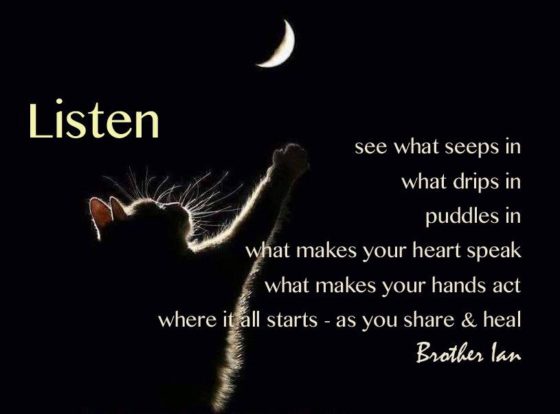
Share & heal.
Then go read your book & sing your song & watch the sunrise – knowing it’s really that simple.

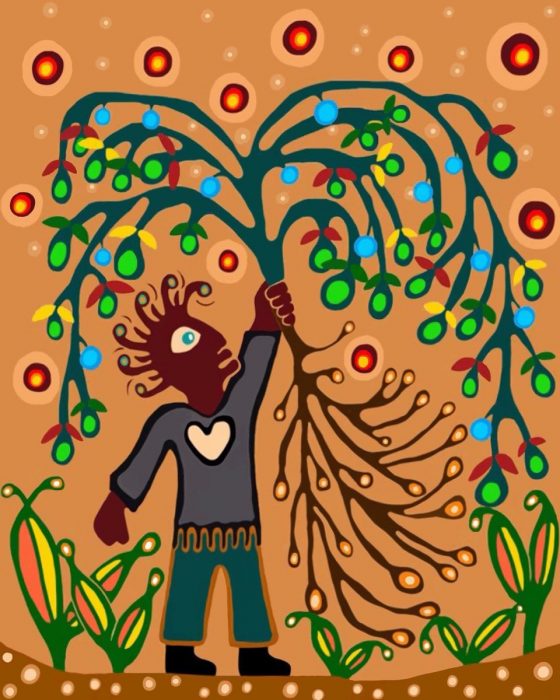
“Peaceful coexistence on this beautiful planet we share cannot be achieved by warfare. It cannot be achieved by power. And it cannot be achieved by ignoring each others’ suffering. We cannot kill our way to peace, oppress others to create to peace, or close our eyes to achieve peace.
“Peace is the only path to peace. Our humanity is indelibly linked to our treatment of one another.”
― L.R. Knost
Art by Isaac Murdoch

 It actually doesn’t matter where you have been swimming, or where you’re going to, but it does better where you’re swimming right now. It is only when we identify what grows in this moment that we have the chance to live fully.
Before & after – this leads to growth in our heads. Now – this leads to growth in our hearts.
It is within this mode of operating that we can grow and grow and grow.We find this by living each moment fully. That creates moments that are more memorable & a future that is more attainable.
You just watch.
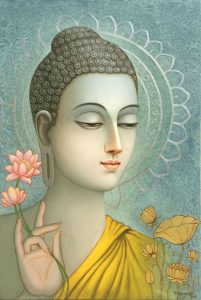 One day the Buddha held up a flower in front of an audience of 1,250 monks and nuns. He did not say anything for quite a long time. The audience was perfectly silent. Everyone seemed to be thinking hard, trying to see the meaning behind the Buddha’s gesture.
Then, suddenly, the Buddha smiled. He smiled because someone in the audience smiled at him and at the flower. The name of that monk was Mahakashyapa. He was the only person who smiled, and the Buddha smiled back and said, “I have a treasure of insight, and I have transmitted it to Mahakashyapa.”
That story has been discussed by many generations of Zen students, and people continue to look for its meaning. To me the meaning is quite simple. When someone holds up a flower and shows it to you, he wants you to see it. If you keep thinking, you miss the flower. The person who was not thinking, who was just himself, was able to encounter the flower in depth, and he smiled.
That is the problem of life. If we are not fully ourselves, truly in the present moment, we miss everything. When a child presents himself to you with his smile, if you are not really there—thinking about the future or the past, or preoccupied with other problems—then the child is not really there for you. The technique of being alive is to go back to yourself in order for the child to appear like a marvelous reality. Then you can see him smile and you can embrace him in your arms.
~ Thich Nhat Hanh

In the old days, one of the cool jobs I was lucky enough to fall into was teaching drama at a junior high. We had a great time. One of the things we did was improvise scenes.
It was easy – we’d put two or three kids on the floor, give them a first line (something like “What do I do now?” or “Why, tell me why you had to do that!” or “You’re not the person I thought you were!” or something), and then say “Go!”
Then their job – everybody else’s – was to carry the scene forward with whatever came up. No rules (junior high kids LOVE that), no script, with a wide-open road as to where things might go. Usually it was fun – sometimes really funny (usually unintentionally), sometimes emotional, sometimes as mixed up as life. The part we were looking for: When you’re off-script, it’s a little scary, but often honest.
Every so often, we’d get it going, maybe with saying, “What do I do now?” and…the kid would respond with, “I don’t know.” Then the first person would say, “OK,” and we’d be done. So then we’d use the same people and start it with, “Wow, you look funny!” and they might respond, “Oh, OK. Thanks for telling me.” And we were done.
We really didn’t want things to die there.
So then we had to make some rules for this no-rule lesson plan. Frankly, I don’t remember them, ’cause I used to, well, improvise. But I heard that Tina Fey (in this article) has these as her Improv Rules:
The Rules of Improvisation
Always Agree.
Say Yes, AND…
After the “and” add new information.
Focus on the Here and Now.
Establish the location.
Be Specific, provide details.
Now that changes things. That makes you want to stay in the conversation, and see how it turns out. Part of improv comedy’s genius is the ability, even necessity, to say, “Yes! And…” even in the face of the strangest things. In real life, we just end the conversation & walk on.
Wait. Maybe we don’t have to create a “real life” like that. The more I think about it, I like the Rules of Improv. Good way to wrestle with the stuff that comes our way.
I have an early night, so I think maybe you & I will visit about this some more. Because that’s the way you are…I say something, and no matter what, you agree, so that you can say “Yes! And…” (not “Yes! But…”) and we take it from there. And that’s why it’s fun talking to you. I love it.
Love you & the way we make all this up, together.
Brother Ian
+++++++++++++
See more of Agoes Antara’s awesome work.
 Over the centuries, Brother Ian has been collecting stories & information & discourses for the purpose of elevating the human condition as needed, dissecting it when necessary, and building the case for hope.
In the spirit of noting that organized crime, organized baseball, organized labour, and organized religion tend to engender controversy & occasional discord, I promise to be neither organized or critical of those who are.